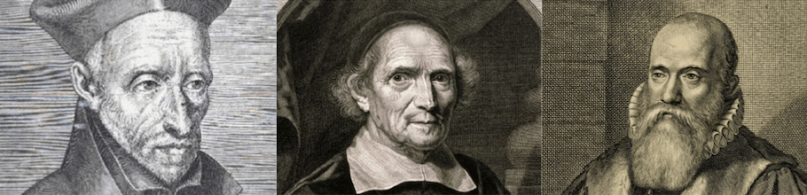
The Problem of the Intellect and Will Concerning Freedom

The definition of ‘free choice’ and the outworking of the topic are mutually dependent. According to the definition that is summarized by the ability to exercise an act and the ability to withhold that same exercise, it remains obscure as to whether that power to act and not act remains, since a man does not simultaneously act and not act a particular action. The fact that one act is chosen leads some to add an additional end to the definition, namely to choose from one of the optional means that lead to a certain goal. This “certain goal” is highlighted in the definition of Fransiscus Gomarus.1 Yet there are debates as to whether this “certain goal” would introduce necessity to the exercise of the power to act and not act. 

The views of the Jesuit philosopher and theologian, Francisco Suarez, and the Reformed theologian, Gomarus’s pupil, Gisbertus Voetius concerning free choice do not appear to be compatible. They both appear to agree, however, that the faculty of free choice should be distinguished separately from the intellect; but they disagree as to whether that faculty is impeded if the last judgment of the practical intellect should necessarily prevail in the choice. Suarez says that the free faculty would indeed be impeded and thus he is against the intellect necessarily having its way in the final choice. Voetius affirms that the intellect does have its way.

The purpose of this paper is to set out an interpretation of the disagreement alongside the proposal that the intellect and the will are not distinctly separate when it comes to our definition of freedom. However, this interpretation admits no solution apart from the question of God. However, it is rather necessary to hold to a unity of both the intellect and will, and a unity of both the goal-oriented and the power-to-not-choose aspects of freedom. Even though, here, we will not thoroughly examine the theological issues, we propose a way that is more dependent on theology than any other alternative concerning the problem of freedom. Our wholehearted dependence on theology is signified by our continuing reflection on the lack of created intermediaries between the Creator and the creature. The freedom of the rational creature is defined by the lack of created intermediaries imposing necessity upon the self. However, the lingering question that finally arises is whether the positive power to act pertaining to the absolute good is accompanied by a complimentary power to do otherwise.

Suarez’s Definition of Freedom

Fransisco Suarez’s main argument is indeed attached to his definition of freedom. The attachment is located in the second part of his definition which goes as follows; first, “an active faculty that of itself and by its own internal ability has the power to exercise its action and the power to withhold its action;” second, “when this faculty exercises its act, it is disposed and proximately prepared […] for its work in such a way that, with all the things required for acting having been posited, it is able to act and able not to act.”2

Suarez employs the second part of his definition for the purpose of stating that it is insufficient that the free faculty would be free from being necessitated toward certain actions, but also free from necessity in its “exercise” of certain actions (=objects). Thus, a concept of divine concursus that is formulated so that the divine act impedes the free faculty in its action in a way that the faculty is determined to one effect in its exercise is, in Suarez’s mind, a concept that is against good reason and also the Christian Faith. It is against the Christian Faith since the church fathers affirm that the rational creature indeed has this free faculty.3

Suarez first makes the distinction between the free faculty itself and the exercise of the faculty when he addresses the view of certain Thomists4 who say that it is sufficient for freedom that the free faculty not be determined by the object to one effect . Suarez says that “this position assumes that no cause can impose necessity on the will except the object or except by the mediation of the object,” which is an assumption that Suarez thinks is false since God “can also impose necessity on the will.”5 For Suarez, God can impose necessity on the will (yet that power does not entail that God does impose necessity etc.), but the case of God’s imposition would make the faculty not free even though necessity is not imposed on it by the object itself. 

When it comes to all that is required for an act of the faculty, Suarez says there is an ‘antecedent act’ that is required, which is either a condition with a proper principle or the mere condition itself, which he calls the “first act.” This first act is distinct from the free action itself, which is called the “second act.” And so anything that is also required for this free action as an addition to the faculty itself is said to be required ‘concomitantly.’6

A physical (or even an intellectual) ability to operate in a given way, such as, for example, an ability to inscribe, belongs to the first antecedent act rather than the second, for if one had not the ability, a non-action does not proceed from the free faculty that chooses. Suarez sharply asserts that what belongs to the antecedent act might indeed include the intellectual reasoning of a rational creature. He says “when the will itself fails to act because of natural inattention on the part of reason, this absence of an act proceeds not from [a free act] but rather from an inability to operate.”7 The proposed scribe might fail to make an inscription because he has not learned the craft, or because his reasoning fails to propose that a choice to inscribe is truly relevant to the situation at hand. Both scenarios, in the case where there is no act of inscribing, belong to the first act; the free faculty (and thus the second act) is excluded. 

Suarez then employs the distinction between antecedent and concomitant acts in his consideration of divine concursus. He says, in accordance with the two acts required for the creature, “God’s movement of our will can be understood to be of two types:” one “is antecedent to God’s actual concurrence with respect to the will’s action; the other type consists in the actual concurrence itself.”8 Thus, with respect to the will’s action, there is only one actual concurrence, which is the divine concurrence that is required for the second act and not the first. With regard to the distinct divine motion that is required for the first act, Suarez says that such motion is not demonstrated philosophically; for the antecedent motion in question belongs to the topic of theology; and so Suarez reserves this for a separate discussion. What he does assert is that whatever is concluded from divine actions concerning the first act does not categorically make the first motion belong to that which determines the free faculty (second act) to one effect. But the actual divine concursus concerning the second act “is essentially included,” as Suarez puts it, “in the will’s very action.”9 It is not further explained by Suarez how this actual divine concurrence works, and yet it is apparent to us that any attempt to introduce any temporal causality to the equation renders the divine act to be antecedent rather than concomitant.

While Suarez affirms the concomitant act of the divine in all acts of the free faculty, he does not likewise include the intellect in the free action. Suarez asserts that the judgment of the intellect that concludes what is good, even if the judgment “is a second act in the intellect, [it] is nonetheless related to the will as a first act.”10 For example, if a man chooses to journey to Rome rather than Jerusalem, his judgment that it is better to go to Rome because the city has better pizza belongs to the first act in relation to his choice (second act) to go to Rome. Suarez, overall, is decidedly against the judgment of intellect (even the final judgment) determining the will to one effect; he does not grant that the intellect is concomitant with the exercise of the free faculty.

Since, for Suarez, divine act is exclusive to being concomitant with the exercise of the free faculty, we observe that there is no intermediary between the divine and the rational creature in the free action.

Suarez’s Problem of the Intellect in Gomarus and Voetius

Suarez is in no way denying that the free faculty operates without the intellect, for only a rational creature has the free faculty; but the intellect itself belongs to the antecedent that grants the power to act which is then freely chosen. Yet the judgment of the intellect also seems to depend on free choice. However, this apparent codependence of the intellect and will should first raise the question of the will’s dependence on the intellect. The question might be asked in two ways. First, whether or not the intellect is a necessary component in the antecedent to a free action, even if it is not always regarded as most proximate to the action. The second way we might ask the question is whether there is any notion of ‘intellect’ that might be considered concomitant with a free action. Suarez, who has made his distinction between what is antecedent and concomitant to free actions, denies the postulation that the intellect is concomitant to the free faculty. Some Reformed theologians, however, venture to think that the intellect and will are really the same free faculty. And yet the ‘antecedent/concomitant’ distinction found in Suarez is not always made clear in Reformed writings. Fransiscus Gomarus (1563-1641), a Reformed professor at Leiden University, gives attention to the apparent lack of separation between the will and the intellect. The translators of Gomarus’s “Theological Disputation on Free Choice” prefer to call free choice a power that belongs to a “mind-gifted nature.”11 Gomarus’s treatment of free choice appears to emphasize, more than Suarez, the singular goal that is involved in the free faculty’s operation, which is also shown by the fact that one thing is chosen as a means to a certain goal. Suarez is strict to postulate any notion of a goal with the antecedent, whereas Gomarus does not provide such strictures. He rather states the ‘goal’ in the same breath with the power to act and not act, even observing the likeness of intellect and will in these distinctions. Gomarus says:

It is the same faculty: with regard to a goal it is called will (voluntas); with regard to the means, however, it is called free choice (liberum arbitrium), just as the one intellective potency is called intellect (intellectus) with regard to the first principles, and is called reason (ratio) in so far as it draws conclusions.12 

Gomerus does appear to resolve how the “same faculty” might achieve the freedom that his definition proposes. While it is the same faculty, he only employs the word “freedom” (liberum) alongside the word arbitrium and not voluntas, leaving us to question what freedom might have to do with voluntas. We will further attend to this proposal of the “same faculty” in our interpretation of the problem further below. 

Gomarus’s pupil, Gisbertus Voetius (1589-1676), discusses a three-fold consideration of necessity in “The Freedom of the Will.” The three components that accompany the human exercise of choice are the divine decree, divine premotion, and the last practical judgment of the intellect. Voetius, who affirms God to be an efficient cause of the operation and effects of human free will, is opposed to any notion of formal causality being said of the divine; formal causality rather belongs squarely to the rational creature.13 In view of the divine decree being depended upon by the rational creature, Voetius says “when it comes to the connatural mode of acting, the [created] will is not more necessitated by the decree than by itself.”14 Voetius states that “the end point of both God who decrees from eternity and the creature who operates in time in a rational way, is the same.”15 For Voetius, the divine decree itself is not said to have any formal operation in what belongs to the rational creature’s free operation, which, alone, is the formal cause of the act. Divine premotion, also, does not turn the creature towards an act that the creature, in its free operation, would not have acted himself. For it is not the necessity of natural cause, but a free cause, a most-wise cause, that “turns the will sweetly and nevertheless strongly to that very end, to which it–certainly being moved and premoved by God–would have turned itself.”16 The question remains of whether, in this divine premotion, any created nature is involved in positing  necessity on the free operation of the will.17 Voetius finally lands with the third kind of necessity, a necessity that involves the creature’s intellect, and therefore this necessity includes created natures; for the intellect is indeed a created nature. Voetius says that the ultimate practical judgment of the intellect “removes from freedom only indifference in the compounded sense.”18 Thus, according to Voetius, the ultimate practical judgement of the intellect is both necessary to free operation of the will and also imposes necessity to the act of the will, yet only in the compounded sense.19 The result of Voetius’s formulation, is that the free faculty of the will is not free in the highest possible sense; for it is not free from created causes imposing necessity.20

Suarez, on the other hand, does not assert that any intellect act would render the free faculty determined to one effect. Both Suarez and Voetius agree that the object does not itself impose necessity upon the free faculty; but for Suarez, contra Voetius, there is no notion of the intellect’s judgment that renders the act of a free faculty to be necessary, even in the compounded sense.

Gomarus’s general assertion that the intellect and the will are the same faculty poses many questions that Voetius attempts to put in order. That order always gives primacy to the intellect; thus it does not agree with the notion of any overall power to do otherwise, nor does it account for situations where intellectual judgment does not stand in the closest proximity to the choice.21 Surely if there are different degrees to the intellect’s operation, we might ask whether the intellect is completely inoperative in the free faculty’s exercise, which is the formulation of Suarez, or else whether there might be a possible incompatibility in the succession of judgments (antecedently) leading to the last judgment pertaining to the free act.

A reflection on free choice leads us to ponder whether a rational creature always has some degree of action that could be otherwise (possibly even while sleeping); this is a question whether the free faculty itself is always operating positively. We might conclude that the only actions that could not be otherwise are the acts that do not pertain to the intellectual power; and thus we have established some level of dependence of freedom upon the intellect. If we are willing to, however, consider that they are the same faculty, then our reflections on whether the rational creature has some level of action that could be otherwise (which proposes an endless relationality of actions) has bearings also on questioning whether such continuity is also seen in the intellect.22 The proposition also maintains our central question of whether there are created intermediaries between the rational creature and the Creator; if the created intellect were to play an intermediate role, such as in the formulation of Voetius, then the intellect is really necessary as a domineering intermediary for divine concursus.

Our Proposal for the “Same Faculty” and its Demand for Theology

In Voetius’s formulation, we cannot distinguish whether the last judgment of the practical intellect is antecedent to the free act or a simultaneous component of the free act. If we propose the latter, then the simultaneity of the intellectual judgment and the act itself proposes either a logical (atemporal) order of the intellect necessitating the will that acts,23 or else that the intellect and the will are codependently acting in the free action. If we were to interpret Voetius as positioning the particular act of the intellect as concomitant with the action, we must also interpret a logical priority of the intellect to the will. If we were, however, proposing a codependent identity of the intellect and will in the free action, and combining it as the free faculty, then we encounter the problem of whether the faculty necessitates itself to one effect, which appears to contradict freedom, or else whether there is an assertion of freedom in the intellect’s practical judgment. Freedom in practical judgment is considered in the following way: the object (the act) itself is not thought to be the best option but is rather seen indifferently; yet this conclusion appears to contradict the very definition of practical judgment, which identifies what is good in comparison to lesser goods. 

If we grant that the intellect is operating simultaneously, effectively, and directly unto the object, then we must (highlighted in the formulation of Suarez) acknowledge a potential break between the intellectual acts that belong antecedently to the act and the act itself; and thus any line of reasoning that is antecedent to the last judgment cannot be depended upon by the last judgment. This break is seen in the example of a man who judges that it is best for him not to eat pizza because he needs to make healthy gains but rather chooses to suspend this judgment seemingly to satisfy a less-rational craving of the body. If we say that the final choice is also the final judgment of the practical intellect, it is difficult to defend that the final judgment has elicited the best possible world since it has broken away from an evidently better judgment.

This scenario would support the idea of the last practical judgment of the intellect being of itself not determined to one effect, even though it sounds absurd. Yet we must note that the free faculty (the ability to do otherwise) is always active even when considering any intellectual act of the antecedent, which, even when it is not finally proximate to the free action itself, must be nevertheless present when considering all that is antecedently required for a free action. In other words, there is no break in the free faculty (according to Suarez’s definition of the word) since the free-choosing person is also antecedently active as a free-choosing person. The man who chooses to suspend his judgment might prove that his better judgment itself is not determined to one effect as it also resembles freedom in this way. Both Suarez and Voetius appear to deny this conclusion regarding the intellect, but in different ways in consideration of the free faculty. Suarez denies the intellect’s power to one effect over the free faculty, and Voetius affirms it.

Our proposed alternative indeed raises an apparent contradiction regarding the intellect. The object in the intellect is indeed the act in consideration, but we are not (by definition of ‘intellect’) considering the act chosen or not; it is rather what a rational creature deems to be the best course of action. Antecedent to the act, the mind can determine a different course that is deemed to be best, but if the act simultaneously includes what is deemed to be best, how can the same act also be possibly deemed not best at that same time of action? for there is no time for a change of mind. There must be some degree of indifference to the judgment; but how can the best course of action also simultaneously be deemed not the best as that particular act is chosen?

Bernardinus de Moor highlights a distinction between theoretical and practical judgment in his “Continuous Commentary” that here includes commentary on a certain passage in “The Compendium of Christian Theology of John à Marck”. De Moor compares what he calls “the honest good” with “the useful and the pleasant good.”24 Of the second kind, which is ‘practical judgment,’ De Moor says that this judgment is “always followed by the will.”25 The first kind of judgment (theoretical) might possibly be contrary to the second kind and therefore is not the one that is followed by the will. Here, continuing with our example, imagine that our health-conscious man has the choice to eat chicken with broccoli or else pepperoni pizza. Let us suppose that chicken with broccoli is always the best choice (regardless of the other options) as a means to the goal of healthy gains; thus it is a theoretical judgment. And yet the man chooses to eat pizza because it satisfies his lower cravings. This event either proves Suarez to be correct that the intellectual judgment does not determine the free faculty to one effect, or else it demands for the last judgment to be distinguished from the first; for the last judgment, for de Moor, is called ‘practical.’ If the first judgment is indeed retained while the will simultaneously follows the second judgment, then the first is both deemed the best course of action and yet not the best course of action.

This apparent contradiction is not a contradiction if we consider the difference in the goal. It is curious that the man would choose a lesser goal (satisfying bodily cravings) over a greater goal; but his judgment pertaining to the greater goal is not necessarily modified, for he still judges that chicken and broccoli are the best for his health, thus retaining his theoretical judgment, while also judging that his health is not the most important goal in that particular instance. Thus, the man is neither determined to a certain act (the means to a goal), nor is he determined to a certain goal; yet he has nevertheless acted according to his judgment; and his second judgment has not suspended the first. Yet an objection arises in this case since the man’s choice of pizza appears to completely nullify the goal of health; therefore his first goal is contradicted by his choice, and thus the first judgment has no operation in the choice. This objection would indeed be valid if we have claimed that health is always the man’s best goal; but this claim has not been made. Our claim that chicken and broccoli are always the best for his health has not presupposed that health is always the best goal for the man. Therefore our particular theoretical judgment is not wholeheartedly absolute. However, the two goals still appear to be against one another if indeed health is always a greater goal compared with lower cravings.

J. Martin Bac’s commentary on the work of de Moor distinguishes not one but two kinds of judgment apart from the third kind (the third being the final judgment followed by the will).26 However, the first kind (theoretical) and the second (absolute practical) are both not distinguished as what we have considered to be truly absolute.27 The truly absolute is what is deemed to always be the best goal for the man. The Christian faith, in multiple mainline traditions, declares that the absolute goal is God. However, even philosophically speaking, whatever we identify as the final goal serves to address our problem of whether the man, in our case, who appears to seek the lesser goal, has made two judgments that are incompatible. First we must consider that if God (absolute being) is indeed the final goal, we need to determine whether any other goal (such as the goal of health) would necessarily compromise that final goal. If it is possible to have lesser goals without diminishing the final goal, then we retain the possibility that a lesser goal might be compatible with the greater goal. Yet if it is possible that a lesser goal be incompatible with a greater goal, such as the goal of murdering an innocent man (made in the image of God) standing together with the goal of God, then it is possible that the goal of quickly satisfying bodily cravings might be incompatible with the goal of long-term health. However, if we consider that the final goal is always the greatest, we might say that it is possible that the goal of health is incompatible with the final goal,28 and that it is also possible that the goal of satisfying bodily cravings is compatible with the final goal. Therefore, even when there is no compatibility between health and cravings in themselves, the judgment of the man is still able to hold both goals in consistency alongside the final goal in the case where he judges the lesser goal to be better in his final choice. And yet, on the other hand, it is still also possible that he is wrong. Christians might be right to call this act a sin. But a sin is not necessarily a sin unless the final goal is neglected. Thus the man can be wrong for choosing what he craves while holding to the goal of health, but he might also be right before God.

This scenario is another way we can highlight the fact that God is necessarily concurring with the act of the rational creature without an intermediate (created) agent imposing necessity on the act. Theoretically, therefore, the one who sins is sinning against God without an intermediate cause and is thus sinning freely; for there is no created cause imposing necessity. However, the sinner also appears to be bound to sin since he no longer freely judges God to always be the goal; judging that “God is always the goal” in light of even a single instance of God not being the goal necessitates repentance together with a positive act that makes the man once again freely say “God is always the goal” without any incompatibility with the rational creature’s previous judgments.

In Reformed Christianity, that positive act (divine grace) that accompanies repentance is on the same plain with the act of existing. No rational creature can say in the first person that “I could have accomplished my own existence” nor “I could have done otherwise and never existed” when it comes to existing as that person; neither can a redeemed person say “I could have done otherwise” as it pertains to the ultimate goal any more than he could say “I could have redeemed myself.” The positive part of the equation is much more demanding than the negative; and yet even the negative demands more than what the means by themselves can accomplish. Therefore the sinner is ever bound to the goal of self-existence since he will never accomplish that goal, and yet he is free from all the means that he could choose since none of them too can accomplish his goal. The freedom of those who are saved is even a greater mystery since they also include means that are chosen for the goal that declares “I wholeheartedly trust God.” 

Conclusion

Since there is no space remaining in this paper for the seemingly endless theological inquiries that are due, I grant that there is no singular conclusion that results from our thinking. However, the key to digesting the most important considerations we have made boils down to our definition of freedom. Is freedom merely the power to act and not act, or does the power to achieve an absolute goal enter intrinsically into the equation? The goal itself necessarily includes intellectual acts prior to the act and the achieving of the goal necessarily demands future volitional acts. If both faculties are acting as one faculty in a present particular act, then we must continue along a theological path to distinguish between freedom and not freedom regarding the free act of the created rational soul.

What we have highlighted in this paper is the continuing perspectival consideration of the rational creature’s freedom from being determined by any created intermediary outside of the self (which makes the self responsible in the case of sin). Our proposal is that both the intellect and will are the self and therefore divine concursus does not propose one to be a necessary means for the operation of the other, but they are rather the same faculty–the ‘ego’–that always depends on the divine for existence and goal-orientation, even in the case where the ‘ego’ has freely bound himself to its own goal. However, when the ‘ego’ wholeheartedly embraces his dependence on the divine, he cannot do otherwise; for, indeed, the creature, like the Creator, is not bound to even the means of any created self. And in this way, the creature cannot but be free.

Works Cited

de Moor, Bernardinus. “Continuous Commentary”. Reformed Thought on Freedom: The Concept of Free Choice in Early Modern Reformed Theology. Willem J. J. van Asselt, Martin Bac. Roelf T. te Velde. eds.  Grand Rapids: Baker, 2010.

Gomarus, Fransiscus. “Theological Disputation on Free Choice”. Reformed Thought on Freedom: The Concept of Free Choice in Early Modern Reformed Theology. Willem J. J. van Asselt, Martin Bac. Roelf T. te Velde. eds.  Grand Rapids: Baker, 2010.

Suarez, Fransisco. On Efficient Causality: Metaphysical Disputations 17, 18, and 19. Translated by Alfred J. Freddoso. New Haven: Yale University Press, 1994.

van Asselt, Willem J. J. Martin Bac. Roelf T. te Velde. eds. Reformed Thought on Freedom: The Concept of Free Choice in Early Modern Reformed Theology. Grand Rapids: Baker, 2010.

Voetius, Gisbertus. “The Freedom of the Will”. Reformed Thought on Freedom: The Concept of Free Choice in Early Modern Reformed Theology. Willem J. J. van Asselt, Martin Bac. Roelf T. te Velde. eds.  Grand Rapids: Baker, 2010.

  1. Fransiscus Gomarus, “Theological Disputation on Free Choice”, Reformed Thought on Freedom: The Concept of Free Choice in Early Modern Reformed Theology. Willem J. J. van Asselt, Martin Bac. Roelf T. te Velde. eds. (Grand Rapids: Baker, 2010) 128. ↩︎
  2. Francisco Suarez, On Efficient Causality: Metaphysical Disputations 17, 18, and 19. Translated by Alfred J. Freddoso (New Haven: Yale University Press, 1994) 319. ↩︎
  3. Suarez, On Efficient Causality, 290. ↩︎
  4. A “Thomist” is a follower of Thomas Aquinas. ↩︎
  5. Suarez, On Efficient Causality, 305. ↩︎
  6. Suarez, On Efficient Causality, 321. ↩︎
  7. Suarez, On Efficient Causality, 322. ↩︎
  8. Suarez, On Efficient Causality, 323. ↩︎
  9. Suarez, On Efficient Causality, 325. ↩︎
  10. Suarez, On Efficient Causality, 323. ↩︎
  11. Gomarus, Reformed Thought on Freedom, 128. ↩︎
  12. Gomarus, Reformed Thought on Freedom, 129. ↩︎
  13. Gisbertus Voetius, “The Freedom of the Will”, Reformed Thought on Freedom: The Concept of Free Choice in Early Modern Reformed Theology. Willem J. J. van Asselt, Martin Bac. Roelf T. te Velde. eds. (Grand Rapids: Baker, 2010) 149. ↩︎
  14. Voetius, Reformed Thought on Freedom, 150. ↩︎
  15. Voetius, Reformed Thought on Freedom, 150. ↩︎
  16. Voetius, Reformed Thought on Freedom, 151. ↩︎
  17. Created natures might even include angels, if not also material and bodily motions. ↩︎
  18. Voetius, Reformed Thought on Freedom, 152. ↩︎
  19. The compounded sense goes as follows: if the judgment of the intellect determines the act, then the will is determined to the one effect. This is in contrast to the divided sense: the will itself is determined to one effect. ↩︎
  20. Obviously, the created intellect is a cause in Voetius’s formulation. ↩︎
  21. For example, when a man is hungry and then chooses to eat what is in front of him; the intellectual judgment is either not operating or else operating weakly in closest proximity to the choice. ↩︎
  22. The discontinuity of intellectual judgment is also seen in the “otherwise” equation of the free faculty. ↩︎
  23. This is a one-way dependence of the will upon the intellect. ↩︎
  24. Bernardinus de Moor, “Continuous Commentary”, Reformed Thought on Freedom: The Concept of Free Choice in Early Modern Reformed Theology. Willem J. J. van Asselt, Martin Bac. Roelf T. te Velde. eds. (Grand Rapids: Baker, 2010) 203. ↩︎
  25. de Moor, Reformed Thought on Freedom, 204. ↩︎
  26. J. Martin Bac, Reformed Thought on Freedom: The Concept of Free Choice in Early Modern Reformed Theology. Willem J. J. van Asselt, Martin Bac. Roelf T. te Velde. eds. (Grand Rapids: Baker, 2010) 214. ↩︎
  27. Or as I put it earlier: “wholeheartedly absolute.” ↩︎
  28. A man might neglect God in his pursuit of health. Health might, in Christian language, be an idol. ↩︎

Love as Strong as Death: An Interpretive Introduction to the Song of Songs as the Holy of Holies of Scripture

All Scripture is Holy. All Jewish and Christian Scripture testifies of the Anointed One. Yet not all who embrace the Pentateuch agree on which books are included in the full canon of Scripture, neither do all agree that Jesus of Nazareth is the Anointed One. When it comes to a small collection of love poems called the “Song of Songs,” Jews as well as Protestant, Roman Catholic, and Eastern Orthodox Christians all agree that the book belongs in the holy canon of Scripture. Moreover, this love poem has been called by the first and second century Jewish Rabbi Akiba, “the Holy of Holies” of the holy writings.[1] The Christian Scripture, which includes twenty-seven New Testament books, testifies that human beings have access to the high-priestly Holy of Holies through Jesus Christ, who is the high priest in the order of Melchizedek (Hebrews 5:10). Christians then can boldly access the Song of Songs with the expectation of meeting the King of kings and Lord of lords in holiness, righteousness, and glory. Yet gazing on the Christ Song also introduces a wellspring of meaning to sex, marriage, and love, so enriching us in language that represents God’s design of love in its modesty, mystery, and danger.

Early Interpreters of the Song of Songs have typically favoured an allegorical interpretation of the book that likens the man and woman to the King and his people, to Yahweh and Israel, and/or to Christ and the church. Some more recent interpreters have favoured a natural/literal interpretation, asserting that the intention of the book is to celebrate marriage, sex and love between a man and a woman. Iain Duguid believes “that it is possible to steer a middle ground between the allegorical and literal extremes.”[2] Since Duguid’s commentary on the Song actually explores both readings, these readings are only extremes if an allegorical reading is antithetical to a literal reading and vice versa. Mark Garcia says that the Song of Songs is “as theologically dense, rich, and powerful a witness to the meaning of everything as you will find in Scripture … if you will hear it as a portion of Christian Scripture.”[3] In writing this introduction to the Song of Songs, I will favour and defend a Christian allegorical interpretation of the text, yet one that continues to multiply fruit as the book’s literal and natural features are unveiled. The Song can be seen as a centerpiece to the whole of God’s revelation, giving light to a systematic, biblical, and natural theology that is deep and ever flowing with richness through our magnifying of these short love poems in their fitness to be called the Holy of Holies of Christian Scripture.

Canonical Interpretation

The very definition of canon, as a distinct collection of holy writings held together as the “rule of faith,” gives us reason to characterize God the Ruler in each canonical book. The canonical writings are holy because God’s holiness is the dominant theme throughout the writings. Thomas Watson says of the Scripture in its canonicity that the “holiness of [Scripture] shows it to be of God;” and he relates the whole of Scripture to the interpretation of its parts: “the sun best discovers itself by its own beams; [likewise] the Scripture interprets itself to the understanding.”[4] The Westminster Assembly agrees that the whole of Scripture is given for the interpretation of its parts:

The infallible rule of interpretation of Scripture is the Scripture itself; and therefore, when there is a question about the true and full sense of any Scripture, (which is not manifold, but one,) it must be searched and known by other places that speak more clearly.[5]

~ The Westminster Confession of Faith I:IX

Since the closed canon is singular as God’s full and complete self-revelation (John 1:18), we should seek the magnificence of God’s character even in the places where Elohim, Yahweh or the persons of the Trinity are not explicitly named. “In the beginning Elohim created the heavens and the earth,” says Genesis 1:1. So God’s spoken word revealed in his handiwork is written on the cosmos (Psalm 19:1). On the sixth day, Elohim said, “Let us make man in our image, after our likeness” (Genesis 1:26). Human beings are made in the image of God and are therefore types of God. The Greek word τύπος, most directly translated in English as type, originally refers to the image of a blow or imprint made by a striking object. The use of the word in philosophy expanded the word’s use to indicate a “sketch or outline” or the “preliminary disclosure of a thing.”[6] Τύπος is no less than an imprinted form made from an object through an impressive action indicating the shape of the acting object, such as a wax stamp; but, according to the term, such an imprint is not necessarily an exact representation of that impressing object.[7] In the New Testament, Jesus Christ is said to be the exact imprint (χαρακτὴρ) of God’s nature (Hebrews 1:3). So Christ is exclusive in that he is not made in God’s image as a mere man, he is “the image of the invisible God” (Colossians 1:15). However, there are human beings who are types of Christ in the Old Testament, so taking their shape from Christ. Paul says that Adam is a type (τύπος) of Christ, even though he was the first sinner (Romans 5:14). So, even though these types are not exact imprints, it is appropriate to say that many Old Testament figures, such as Melchizedek, Isaac, Moses, David and Solomon, are types of Christ insofar as there is resemblance between the type and the one typified. And we can perceive that there is the direct action of God’s creation and providence at work with each impression. So we can gather that these types are not merely persons, they are persons with localized stories, all of which give meaning to all things visible and invisible. The world as we receive and perceive it takes its shape from the eternal Christ.[8] So much more do books such as the Song of Songs and Esther, though they do not explicitly identify God by name, reveal the very character of God in his covenant faithfulness; otherwise, the books are hard-pressed to be recognized in the holy canon.

The Song of Songs ought then to be interpreted with God’s covenant in mind. Interpreters who prefer to focus their interpretation of the Songs as a celebration of the created world without celebrating the Creator and his continuing activity have missed the theme of Scripture. Many natural blessings, many festivals, and many non-canonical books celebrate the created world. There are manifold ways to celebrate God’s creation, but there is only one Scripture which gives full meaning to God’s creation. And that fullness, I will suggest, is God himself in the flesh (John 1:14-18). In Paul’s writing to the Ephesians, the apostle likens the one flesh union of husband and wife to Christ and the church, indeed naming the mystical union of God to his people as the foundation for how we understand the design of marriage (Ephesians 5:25-31).

Yet in modern times, there are some who would prefer an interpretation of the Songs that is somewhat limited to the literal and natural sense, which gazes squarely on human marriage, sex and love apart from magnifying God’s covenant. Old Testament scholar Tremper Longman says, “there is nothing in the Song of Songs itself that hints of a meaning different from the sexual meaning.”[9] Daniel Akin calls the book “God’s instruction manual for sex and marriage.”[10] I will later demonstrate that such assertions do have some importance in counterbalancing the history of the book’s interpretation, but an overall emphasis on the natural reading over and against the allegorical reading reduces the fullness of the Song’s speech.

We receive hints of a greater significance in the Song of Songs beyond a simple celebration of sex through observing language that compares to other parts of the Scripture. The physical features of the lovers’ bodies and the local love setting itself employs words that make echoes of Genesis, such as a garden abounding with flowers and fruit (Song 2:3, 2:12, 4:13), a promised land flowing milk and honey (4:11, 5:1); the text also describes springs and mountains (2:8, 4:12) which echo other parts of the Hebrew literature. The mention of scarlet, fragrances, and anointing oils (1:3, 1:12, 4:3) recall the tabernacle and the priesthood; the mention of cedar and palm trees (1:17, 7:7) recalls Solomon’s temple. Solomon as a king is obviously a key figure in the Song. Regardless of whether David’s son composed the verses with his own hand, the language portrays a wisdom that, through in at least paying homage to Solomon, spreads its poetic richness as living springs flowing into the Torah and the writings.

In observing the whole of the Christian Scripture, Solomon is seen to be a type of Christ. Origen acknowledges this type in observing “first that [Solomon] is called the Peaceable, and also because the queen of the south … came from the ends of the earth to hear [his wisdom].”[11] The New Testament names Christ as very wisdom from God (1 Corinthians 1:30). What is attributed to Solomon is truer of Christ, who is the Holy One through whom the whole world receives wisdom.

The female vocalist is then, for Origen, likened to the queen of the south, for she is “the Church that is gathered from among the Gentiles.”[12] The female also represents the land, the garden, and the city. Francis Landy describes the nature and meaning of the garden as “nature perfected by culture.”[13] In Genesis, Adam was first created in the wilderness then was placed in Yahweh’s garden to work and keep it. Adam was however alone; as beautiful the garden would have been, it was void of common likeness to Adam’s flesh. The garden wasn’t what it was intended to be without human society. So after not a suitable helper was found among the animate creatures, God formed the woman who, in the likeness of Adam, glorified the flesh of Adam the same way the garden glorified the land of Eden. Moreover, the woman and her fruit of human society is the fullness of the cultivated garden extended to the ends of the earth. Adam named the woman “the mother of the living,” for through her fruit, nature is cultivated to become a society, a civilization, a city of eternal fruitfulness.

The man and the woman as lovers are the main vocalists of the Song of Songs, but there is also a chorus of voices that celebrate the love, yet they share especially in the woman’s joy and pain. When the woman is missing her beloved, the chorus feels her pain, singing, “where has your beloved turned, that we may seek him with you?” (6:1). The chorus is thus an extension of the woman, and so the woman is figuratively connected to the vocal society.

Likewise, the figure of Solomon is connected to the man. Even though some have interpreted Solomon to be the male vocalist’s rival,[14] Solomon is never painted to be someone that the woman disdains. Toward the end of the Song, the woman is called a “Shulammite,” which is the name of a female Solomon,[15] a name that is attributed to her both by the chorus and the male vocalist himself (6:13). She glorifies King Solomon and is celebrated as such. The only characters in the Song who are antagonists are the mother’s sons who subject the young woman to sun-stroked labour (1:6) and the little foxes that spoil the vineyard (2:15). Both problems however serve as contributors to the lovers’ admiration for one another.

As the woman represents the people and the man represents the king, some interpreters have been led toward an allegory that is first seen in a political state. Martin Luther calls the Song “an encomium of the political order, which in Solomon’s day flourished in sublime peace.” He then names this peace to be analogous to the eternal peace Christ shares with his people.[16] So, besides the private matters of love alluded to in the text, the Song can also be interpreted by extension to the political sphere.

Allegory and the Avoidance of Flesh

While the allegorical interpretation of the Song of Songs does fit to multiple layers of spiritual and political life, the original theme of the text as a love shared between a man and a woman shows no attempts toward desexualisation. Some interpreters have, however, favoured the allegorical interpretation to a degree that acknowledges the theme of sex only for its utility so that we can say something about spiritual and political matters. Of the Song’s opening reference to lovers’ kisses, Luther says, “this means that God honours this people with his word,” only acknowledging the intimate reference as God speaking “according to the custom of the people of that day.”[17] Origen, who predominantly names the male vocalist to be “the Word of God,” admonishes the reader to rid themselves of “outward” carnality so that the “inner” spiritual meaning of the Song would take shape. Origen not only aims to desexualise the Song, but also dematerialize it, interpreting the theme of a banquet feast as a partaking of words rather than food.[18] Thus, to gain a spiritual understanding, these interpretations have discouraged the reader to fully receive the carnal features of the text.

However, since these are Christian interpretations, the Scripture testifies that the Logos (the Word) has become flesh (John 1:14). Indeed, when John introduces Christ as the Logos, he no longer names Christ as the Logos after the text reveals that the Logos has become flesh. Jesus remains the eternal Logos, for John’s gospel continues to magnify his deity, but it was important for John to make flesh and bones of Jesus’s ministry. The Son of God was a man who grew hungry and thirsty, yet he miraculously fed the multitudes, telling his disciples, “I am the bread of life” (John 6:35); likewise, he wept at the sight of his friend Lazarus in the tomb before raising him from the dead (John 11:28-44). At his final Passover, Jesus distributes the bread and wine as representing his very body and blood. In distributing the bread at the last supper, he does not say, “this is an image of my body,” but rather “this is my body” (Mark 14:22). The carnal features of holy feasting thus give direct meaning to the Word.

Jesus, the Son of God, came as fully human. The woman sings, “My beloved is white and ruddy” (5:10, KJV). Of this verse, John Owen says of Christ that “he is white in the glory of his Deity, and ruddy in the preciousness of his humanity.”[19] Since Jesus is true in both his deity and his humanity, the natural theme of human love needs not to be emptied when favouring the spiritual fullness of the Song. Indeed, the spiritual meaning is fully enriched through considering the carnal features as they are given. Yet we don’t need to exhaust the carnal features as if we live by bread alone. A fleshly exhaustion, for instance, of suffering such as what is portrayed in Mel Gibson’s motion picture “The Passion of the Christ” is not a mandatory passageway for our understanding. It is important in holy worship to physically consume bread that is rendered to our bellies, yet not for the purpose of filling our bellies, but rather of filling our understanding. “Love is as strong as death,” says the songwriter; and so Jesus, by his death, puts the wisdom of the lover’s verse to the test. Since Jesus’s love for his beloved remains true to the point of death, his love is verified, but only that his death is imagined and believed to be a fleshly occurrence. Jesus died according to the flesh so that all our visible experiences of death would be imagined also of the Bridegroom. What comfort can those who are dying draw from the Saviour if the Beloved Saviour had not faced the same agony? It is of Christ’s love that he died in the flesh so that our bodily death, when it is given, would raise our hope toward a resurrected-in-the-flesh holy communion with the Beloved.

So the kisses of the lovers don’t fall short of being fleshly kisses (1:2). Kisses are also not less than an exchange of words; they are rather more than words and flesh. Mouths speak words, they also eat and drink, but mouths also breathe. The communal experience of a shared meal accompanied by words that are breathed forth gives the Song of Songs, and particularly its kisses, a meaning that is amplified in the worship of God. The worship of the Holy King is the exchanging of holy words, the singing of holy songs, the breaking of holy bread, the drinking of holy wine; and breath is given to a faith, hope and love that fills and transcends both the sacraments and the words to a third-heavenly reality.[20] The heavenly reality does not posit words against food, but rather gives a full and transcendent meaning to both. Wise words speak of the head, and food nourishes the body; Christ fills both. He also transcends both, as he is the giver of breath—the Holy Spirit, for the kiss represents the most intimate and transcendent elation of Christ’s communion with his bride.

Unseen Mystery

The mystery of sexual desire is then typological to the mystery of communion with God. The words of the Song of Songs preserve the mystery of sex because the text does not exhaust the carnal features of human intimacy. Origen warned those who are spiritually immature to steer clear of the Songs until they are mature enough to not be egged on by the text toward fleshly lust.[21] The caution that Origen expresses toward these matters is in one sense prudent; the Song itself warns of a premature awakening of love; and so both sexual desire and communion with God should be treated with care. Yet since the text is not explicitly sexual in its fleshly depiction, it seems that the hiddenness of the text is sufficient to guard the immature mind from excessive consumption. Moreover, the immature mind may be brought to maturity through a careful reading of the text; and where else can we receive its warnings of danger? In Origen’s day, a person was vulnerable toward carnal lust through the enticements of the public theatre. Over time, developments in technology have provided many more mediums and resources that would exhaust the carnal features of human intimacy in words and images. By exhausting the carnal features, the meaning of love, sex and marriage are robbed of the hiddenness that is intended of these natural delights. The Holy Song can then be a means of restoring the true meaning of sex, a meaning that ripens one to the knowledge of Christ’s gospel, a gospel that is most hidden when it is most revealed.

Many eyewitnesses saw the death of Christ, and many more saw his resurrected body. No one, however, was inside the tomb to witness the dead body come to life; neither did they see his exodus from the tomb. When Mary Magdalene peered into the tomb, she saw two angels at the head and feet of where Jesus had once lain, which is a vision that resembles the tabernacle’s Holy of Holies. Jesus then appeared to Mary as a gardener outside the tomb. And although his resurrection was believed by Mary, Jesus told the woman not to cling to him, for he was to ascend on high to be invisibly seated so that many who don’t see him would believe (John 20:11-18). This woman, like the woman of the Song, experiences multiple absences of her Beloved (3:1-5, 5:2-8), yet the woman, like the church, in her tumult over the Beloved’s absence, doesn’t give up her belief, a belief that is witnessed in the city. So just as Christ’s resurrection in the tomb was hidden, so belief in Christ is a hidden marvel amongst the saints. Jesus had once told Nicodemus that a person must be born again to see the Kingdom of God, and that this spiritual birth is likened to the wind that “blows where it wishes, and you hear its sound, but you do not know where it comes from or where it goes” (John 3:8). Thus the Kingdom of God is most seen as it is most hidden; such is the mystery and marvel of belief.

So the Scripture sings:

Awake, O north wind, and come, O south wind!
Blow upon my garden, let its spices flow.
Let my beloved come to his garden,
and eat its choicest fruits.

I came to my garden, my sister, my bride,
I gathered my myrrh with my spice,
I ate my honeycomb with my honey,
I drank my wine with my milk.

Eat, friends, drink, and be drunk with love!

~ The Song of Songs 4:16-5:1

Christ came to his garden as one conceived of the Holy Spirit. He ate and drank at gatherings to the point that was called a glutton and a drunkard. The people received his ministry as one that resembled a land flowing with milk and honey. Yet his garden was found to be a wild vineyard of death (Isaiah 5:1-2). Christ finally administers and partakes of the bread and wine that signifies his death in private communion. In the Garden of Gethsemane, the final cup awaited him. Jesus sweats as if already pouring out blood; he denies himself when tempted so he would die for his bride. The Eternal Christ held his liquor in drinking the cup of God’s wrath, remaining true to his mission, for he was rather drunk in his intimate acquaintance with his beloved. Noah’s vineyard, representing the post-flood Garden of Eden, made Noah drunk with wine so that his nakedness was prematurely exposed (Genesis 9: 18-28). Jesus was bloodied and naked on the cross, revealing the sins of the world cleansed by baptism, so that the dead wilderness would be resurrected as a garden flowing with springs of living water. The arousal of the wind in 4:16 comes at the time of ripe maturity. The word “awake” or “arouse” is the same word the woman uses in other places to warn the daughters of Jerusalem against a premature arousal of love (2:7, 3:5, 8:4).[22] When Christ drinks of the cup of maturity, the cup of staggering becomes a cup of delight, a cup for resurrected lovers who are no longer ashamed in their nakedness, for they are clothed by their delight for one another!

Conclusion

Biblical interpretation might be comparable to an onion. While systematic theology guards against stripping God of his transcendent deity through naming his being and attributes and his relationship to created things in providential works of redemption for the glorification of Christ; biblical theology explores the depth of layers to the Bible’s many literal features, showing the vastness of special revelation that emanates the many colours and varieties of which the created world speaks of the Creator. The Song of Songs speaks to all the layers of Scripture, shedding light on the Word as a whole, showing how the Christ of Scripture encompasses, indwells, and puts his stamp on the goodness of the created world. Christ speaks into nature and nature speaks of Christ. Therefore sex is to be enjoyed where it is lawfully given since it speaks of the covenantal goodness of God’s creation and providence to the end of glorification. The volume of spiritual allegory in the reading of the Songs is turned up when all the layers of natural life are enjoyed as revelation from God. From this introduction to the Song of Songs as the Holy of Holies of Scripture, I aim to continue to explore the fullness of Christ’s Scripture in a way that gives meaning to all the layers of spiritual and natural life. The Song of Songs acts as Scripture’s centerpiece because it speaks to the heart of life that gives light to an ever-fruitful eternal glory shared in communion with Christ!


[1] Rabbi Akiba, quoted in Francis Landy, Paradoxes of Paradise: Identity and Difference in the Song of Songs, ed. David B. Gunn (Sheffield: The Almond Press, 1983), 13-14.

[2] Iain M. Duguid, Song of Songs, eds. R. D. Phillips, P. G. Ryken, & I. M. Duguid (Phillipsburg, NJ: P&R Publishing, 2016), xviii.

[3] Mark A. Garcia, “The Unveiled Woman at Table: The Zealous Love of the Song of Songs,” The Order of Reality: Sacred Vocation, 2021. Greystone Theological Institute. https://www.greystoneconnect.org/library/the-order-of-reality-sacred-vocation63773/188194/path/step/158805982/.

[4] Thomas Watson, The Scriptures. https://www.monergism.com/scriptures-thomas-watson.

[5] Westminster Assembly, The Westminster Confession of Faith: Edinburgh Edition (Philadelphia: William S. Young, 1851), 20.

[6] Richard M. Davidson, Typology in Scripture (Berrien Springs, MI: Andrews University Press, 1981). 118-119.

[7] Ibid., 116-135.

[8] Mark A. Garcia, “The Intersection of Tuesday with Eternity,” The Order of Reality: Sacred Vocation, 2021. Greystone Theological Institute. https://www.greystoneconnect.org/library/the-order-of-reality-sacred-vocation-63773/188194/path/step/159289768/.

[9] Tremper Longman III, Song of Songs (Grand Rapids, MI/Cambridge, UK: William B. Eerdmans Publishing Company), 36.

[10] Daniel Akin, God on Sex: The Creator’s Ideas About Love, Intimacy, and Marriage (Nashville, TN: B&H Publishing Group, 2003), 5.

[11] Origen, The Song of Songs Commentary and Homilies, trans. R.P. Lawson (New York: Newman Press, 1956), 51.

[12] Origen, The Song of Songs Commentary, 99.

[13] Landy, Paradoxes of Paradise, 190.

[14] BibleProject, “Overview: Song of Songs,” 2016, https://www.youtube.com/watch?v=4KC7xE4fgOw.

[15] Peter Leithart, Alastair Roberts, “Episode 202: Sexuality and Liturgy (Song of Songs),” The Theopolis Podcast, 2019. Theopolis Institute. https://theopolisinstitute.com/podcast/episode-202-sexuality-and-liturgy-song-of-songs/.

[16] Martin Luther, Works: Vol. 15: Notes on Ecclesiastes, Lectures on the Song of Solomon, Treatise on the Last Words of David, Eds. Jaroslav Pelikan and Hilton C. Oswald (St. Louis, MO: Concordia Publishing, 1972), 195.

[17] Ibid., 196-197.

[18] Origen, The Song of Songs Commentary, 24.

[19] John Owen, The works of John Owen, Vol. 2, ed. W. H. Goold (Edinburgh: T&T Clark), 49.

[20] Garcia, “The Unveiled Woman at the Table.”

[21] Origen, The Song of Songs Commentary, 22.

[22] Duguid, Song of Songs, 87.

Christian Freedom: A More Brief Treatment

My goal with this writing is to do a brief overview of Christian freedom. Since freedom is the opposite of slavery, and slavery is one’s subjection to a master possessing the power of death, death is central to how we define free living. For human beings, death is the consequence of sin; and sin is ultimately disobedience to God’s word. Satan, whose name is “the accuser,” is the chief agent of invisible entities that desire power to accuse sinners unto death. But the ultimate power over death belongs to God, that he sent his Son to die a sinners’ death on behalf of sinners so that the Son’s sinless perfection would be credited to those who repent and put their trust in Jesus. This Jesus rose from the dead on behalf of his own perfect life that is joined to his perfecting of many brothers who crucify their own sin at Christ’s cross. Since believers in Christ are joined to Jesus’s resurrection, sinners who trust in Jesus have freedom over death and are therefore free from all authorities who would use sin and death as a threat against freedom. Since a believers’ death rendered to sin has an active expression of obedience to God’s word, Christian freedom is a freedom to obey. Therefore, the free obedience of believers is to pick up one’s cross and follow Jesus, who is the Holy One who lived an obedient life commensurate to his free state as Son to God the Father.

Visible authorities under Jesus’s contemporary invisible domain have three categories: the civil magistrate is a ministry of justice that guards the state through the threat of death so to set boundaries to promote the flourishing of life; the household is a ministry of mercy that gives and nurtures life out of weakness so to build up strength and wisdom against any threat of death; and the visible church is the ministry of death and life, particularly the death and life of Christ the Word joined to the invisible bride so to advance and guard the proper visible and invisible worship of the Triune Creator of all. The church is then finally the most articulate ministry of freedom, since by the Scripture she proclaims the Christ who both upholds justice and forgives sins for the freedom of eternal life. Yet the visible church cannot do away with the other authorities; for it is not fitting for the church to issue capital punishment or to mother a nursing child, but rather to speak to the greater reality of death and life in view of God’s very kingdom and house. Christ, who exited the tomb, is then head over all visible dominions, and yet that invisible headship is shared exclusively with the church invisible, a free dominion that the visible church bears witness to.

Free obedience is then owing to Christ alone. And yet, headed by the Scripture, obedience to Christ is manifestly shown through one’s obedience to earthly authorities. Matters might be commanded by authorities that in themselves have no moral gravity on faith and worship. A civil governor may require citizens to obey daylight savings time, a mother may require of her child a particular way of making the bed, and a clergyman may prefer a pulpit that is made of wood rather than stone. There is often wisdom to why something is commanded over an alternative, but an alternative isn’t necessarily a denial of the Christian faith. The same goes for the decisions each individual is free to make. Though one tree was forbidden, Adam was free to eat of many other trees; but he would have had to learn wisdom in matching the varieties of food to his nutritional needs as well as understand the specific way to cultivate each specie. Once wisdom is learned, however, absolute obstinance against a conscience that has gained wisdom would finally infiltrate one’s moral disposition against proper worship. In the Garden of Eden, the woman’s unwise consideration of the words of an inferior creature accumulated to the eating of the forbidden tree. Yet, for any other tree that God rendered free—that is, for matters “indifferent”—any act of volition, no matter the level pertaining to wisdom, is an act that requires faith not to normalize one choice against others or forbid one choice as a creed for worship; for then it is a superstition. So the necessity of acting in faith links all free choice, on some level, to faith and worship, even when one is free to choose one out of many alternatives. So since the matter of faith has an accountability that pertains to the individual before Christ, individuals should obey authorities by faith if the authorized command would not require the individual to sin. And then the authority would have to answer to matters of faith and worship for themselves, for they are not above the judgment of Christ. The subject’s faithful conforming to a faithless authority is not then faithless. The obedience of the subject is free in Christ. Ordinarily, the free obedience of those subjects would help those in authority be confronted with their own obligation to obey Christ. It is only when the authority commands the subjects to sin should the subject obey God rather than man. The result for the subject might be suffering and even death, but such is joined to the suffering and death of Christ who was raised. And then when obedience to Christ at all costs is shown, the reality that all authorities are called to account before Christ becomes further publicized.

Since the gospel of Christ is a call for all people of all nations to repentance and faith, it is not ideal for Christians to raise their banner of freedom outside civil, familial, and, most of all, ecclesiastical society. Surely the individual must answer to Jesus alone regarding faith and worship, but worship is also communal, and the glory of individual faith is shown in relation to others, for Christ is the answer for all. Jesus Christ entered Jerusalem, and though he was driven outside the camp, he entered his priestly office of the tomb now emptied of corruption, his kingly office by his ascension to the Father’s right hand for his pending judgment of the world, and his prophetic office as he dwells amongst the brethren through breathing forth the Holy Spirit into the church so to prepare the world for his final judgment to the glory of his name. The Son of God gave up his freedom to come to earth as a humble servant to secure his bride—the invisible church who is a holy society of worshipers. So this humility was with Paul, who is free from all, yet was a slave to all so that he might win more (1 Corinthians 9:19). Though Paul was free, for instance, to eat all food, there are occasions when he did not partake of certain foods for the sake of freedom for others. Sometimes, amongst pagans, he would not partake on grounds of informed false worship (1 Corinthians 10:27-29); other times, amongst believers, he would not raise his banner of freedom to eat because doing so would have grieved a premature brother for whom Christ died (Romans 14:14-15). He exemplified the character of Christ, who, though he was a free Son, would not fly away from the cross so to gain the freedom of the brethren.

Therefore the death of death reveals the very character of freedom, for Christ institutes freedom through his free and obedient death. Death to sin means that the power of death has been put to death, and death to sin is made evident by Jesus’s rising from the dead. Visible and invisible authorities who would unjustly threaten death to gain temporal power have forfeited their freedom, for the weakest one is free from the binding of all men and angels through faith in the Holy One. An individual is however not an individualist, since those who are freed from Adam’s posterity of sin are made perfect in Christ, who is the firstborn of many brethren. So the saints, who are contemporarily exiled in a corrupt land, bear the name of Christ in communion so to mortify sin at the cross for the freedom of eternal life, looking to Jesus Christ who shall be glorified in free society when the Bridegroom beholds the bride!