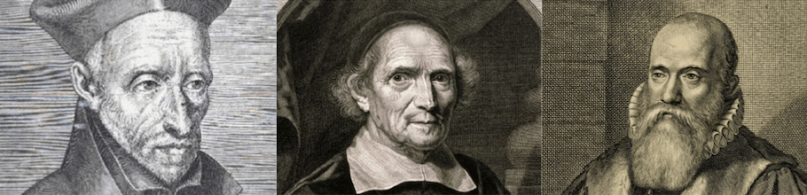
The definition of ‘free choice’ and the outworking of the topic are mutually dependent. According to the definition that is summarized by the ability to exercise an act and the ability to withhold that same exercise, it remains obscure as to whether that power to act and not act remains, since a man does not simultaneously act and not act a particular action. The fact that one act is chosen leads some to add an additional end to the definition, namely to choose from one of the optional means that lead to a certain goal. This “certain goal” is highlighted in the definition of Fransiscus Gomarus.1 Yet there are debates as to whether this “certain goal” would introduce necessity to the exercise of the power to act and not act.
The views of the Jesuit philosopher and theologian, Francisco Suarez, and the Reformed theologian, Gomarus’s pupil, Gisbertus Voetius concerning free choice do not appear to be compatible. They both appear to agree, however, that the faculty of free choice should be distinguished separately from the intellect; but they disagree as to whether that faculty is impeded if the last judgment of the practical intellect should necessarily prevail in the choice. Suarez says that the free faculty would indeed be impeded and thus he is against the intellect necessarily having its way in the final choice. Voetius affirms that the intellect does have its way.
The purpose of this paper is to set out an interpretation of the disagreement alongside the proposal that the intellect and the will are not distinctly separate when it comes to our definition of freedom. However, this interpretation admits no solution apart from the question of God. However, it is rather necessary to hold to a unity of both the intellect and will, and a unity of both the goal-oriented and the power-to-not-choose aspects of freedom. Even though, here, we will not thoroughly examine the theological issues, we propose a way that is more dependent on theology than any other alternative concerning the problem of freedom. Our wholehearted dependence on theology is signified by our continuing reflection on the lack of created intermediaries between the Creator and the creature. The freedom of the rational creature is defined by the lack of created intermediaries imposing necessity upon the self. However, the lingering question that finally arises is whether the positive power to act pertaining to the absolute good is accompanied by a complimentary power to do otherwise.
Suarez’s Definition of Freedom
Fransisco Suarez’s main argument is indeed attached to his definition of freedom. The attachment is located in the second part of his definition which goes as follows; first, “an active faculty that of itself and by its own internal ability has the power to exercise its action and the power to withhold its action;” second, “when this faculty exercises its act, it is disposed and proximately prepared […] for its work in such a way that, with all the things required for acting having been posited, it is able to act and able not to act.”2
Suarez employs the second part of his definition for the purpose of stating that it is insufficient that the free faculty would be free from being necessitated toward certain actions, but also free from necessity in its “exercise” of certain actions (=objects). Thus, a concept of divine concursus that is formulated so that the divine act impedes the free faculty in its action in a way that the faculty is determined to one effect in its exercise is, in Suarez’s mind, a concept that is against good reason and also the Christian Faith. It is against the Christian Faith since the church fathers affirm that the rational creature indeed has this free faculty.3
Suarez first makes the distinction between the free faculty itself and the exercise of the faculty when he addresses the view of certain Thomists4 who say that it is sufficient for freedom that the free faculty not be determined by the object to one effect . Suarez says that “this position assumes that no cause can impose necessity on the will except the object or except by the mediation of the object,” which is an assumption that Suarez thinks is false since God “can also impose necessity on the will.”5 For Suarez, God can impose necessity on the will (yet that power does not entail that God does impose necessity etc.), but the case of God’s imposition would make the faculty not free even though necessity is not imposed on it by the object itself.
When it comes to all that is required for an act of the faculty, Suarez says there is an ‘antecedent act’ that is required, which is either a condition with a proper principle or the mere condition itself, which he calls the “first act.” This first act is distinct from the free action itself, which is called the “second act.” And so anything that is also required for this free action as an addition to the faculty itself is said to be required ‘concomitantly.’6
A physical (or even an intellectual) ability to operate in a given way, such as, for example, an ability to inscribe, belongs to the first antecedent act rather than the second, for if one had not the ability, a non-action does not proceed from the free faculty that chooses. Suarez sharply asserts that what belongs to the antecedent act might indeed include the intellectual reasoning of a rational creature. He says “when the will itself fails to act because of natural inattention on the part of reason, this absence of an act proceeds not from [a free act] but rather from an inability to operate.”7 The proposed scribe might fail to make an inscription because he has not learned the craft, or because his reasoning fails to propose that a choice to inscribe is truly relevant to the situation at hand. Both scenarios, in the case where there is no act of inscribing, belong to the first act; the free faculty (and thus the second act) is excluded.
Suarez then employs the distinction between antecedent and concomitant acts in his consideration of divine concursus. He says, in accordance with the two acts required for the creature, “God’s movement of our will can be understood to be of two types:” one “is antecedent to God’s actual concurrence with respect to the will’s action; the other type consists in the actual concurrence itself.”8 Thus, with respect to the will’s action, there is only one actual concurrence, which is the divine concurrence that is required for the second act and not the first. With regard to the distinct divine motion that is required for the first act, Suarez says that such motion is not demonstrated philosophically; for the antecedent motion in question belongs to the topic of theology; and so Suarez reserves this for a separate discussion. What he does assert is that whatever is concluded from divine actions concerning the first act does not categorically make the first motion belong to that which determines the free faculty (second act) to one effect. But the actual divine concursus concerning the second act “is essentially included,” as Suarez puts it, “in the will’s very action.”9 It is not further explained by Suarez how this actual divine concurrence works, and yet it is apparent to us that any attempt to introduce any temporal causality to the equation renders the divine act to be antecedent rather than concomitant.
While Suarez affirms the concomitant act of the divine in all acts of the free faculty, he does not likewise include the intellect in the free action. Suarez asserts that the judgment of the intellect that concludes what is good, even if the judgment “is a second act in the intellect, [it] is nonetheless related to the will as a first act.”10 For example, if a man chooses to journey to Rome rather than Jerusalem, his judgment that it is better to go to Rome because the city has better pizza belongs to the first act in relation to his choice (second act) to go to Rome. Suarez, overall, is decidedly against the judgment of intellect (even the final judgment) determining the will to one effect; he does not grant that the intellect is concomitant with the exercise of the free faculty.
Since, for Suarez, divine act is exclusive to being concomitant with the exercise of the free faculty, we observe that there is no intermediary between the divine and the rational creature in the free action.
Suarez’s Problem of the Intellect in Gomarus and Voetius
Suarez is in no way denying that the free faculty operates without the intellect, for only a rational creature has the free faculty; but the intellect itself belongs to the antecedent that grants the power to act which is then freely chosen. Yet the judgment of the intellect also seems to depend on free choice. However, this apparent codependence of the intellect and will should first raise the question of the will’s dependence on the intellect. The question might be asked in two ways. First, whether or not the intellect is a necessary component in the antecedent to a free action, even if it is not always regarded as most proximate to the action. The second way we might ask the question is whether there is any notion of ‘intellect’ that might be considered concomitant with a free action. Suarez, who has made his distinction between what is antecedent and concomitant to free actions, denies the postulation that the intellect is concomitant to the free faculty. Some Reformed theologians, however, venture to think that the intellect and will are really the same free faculty. And yet the ‘antecedent/concomitant’ distinction found in Suarez is not always made clear in Reformed writings. Fransiscus Gomarus (1563-1641), a Reformed professor at Leiden University, gives attention to the apparent lack of separation between the will and the intellect. The translators of Gomarus’s “Theological Disputation on Free Choice” prefer to call free choice a power that belongs to a “mind-gifted nature.”11 Gomarus’s treatment of free choice appears to emphasize, more than Suarez, the singular goal that is involved in the free faculty’s operation, which is also shown by the fact that one thing is chosen as a means to a certain goal. Suarez is strict to postulate any notion of a goal with the antecedent, whereas Gomarus does not provide such strictures. He rather states the ‘goal’ in the same breath with the power to act and not act, even observing the likeness of intellect and will in these distinctions. Gomarus says:
It is the same faculty: with regard to a goal it is called will (voluntas); with regard to the means, however, it is called free choice (liberum arbitrium), just as the one intellective potency is called intellect (intellectus) with regard to the first principles, and is called reason (ratio) in so far as it draws conclusions.12
Gomerus does appear to resolve how the “same faculty” might achieve the freedom that his definition proposes. While it is the same faculty, he only employs the word “freedom” (liberum) alongside the word arbitrium and not voluntas, leaving us to question what freedom might have to do with voluntas. We will further attend to this proposal of the “same faculty” in our interpretation of the problem further below.
Gomarus’s pupil, Gisbertus Voetius (1589-1676), discusses a three-fold consideration of necessity in “The Freedom of the Will.” The three components that accompany the human exercise of choice are the divine decree, divine premotion, and the last practical judgment of the intellect. Voetius, who affirms God to be an efficient cause of the operation and effects of human free will, is opposed to any notion of formal causality being said of the divine; formal causality rather belongs squarely to the rational creature.13 In view of the divine decree being depended upon by the rational creature, Voetius says “when it comes to the connatural mode of acting, the [created] will is not more necessitated by the decree than by itself.”14 Voetius states that “the end point of both God who decrees from eternity and the creature who operates in time in a rational way, is the same.”15 For Voetius, the divine decree itself is not said to have any formal operation in what belongs to the rational creature’s free operation, which, alone, is the formal cause of the act. Divine premotion, also, does not turn the creature towards an act that the creature, in its free operation, would not have acted himself. For it is not the necessity of natural cause, but a free cause, a most-wise cause, that “turns the will sweetly and nevertheless strongly to that very end, to which it–certainly being moved and premoved by God–would have turned itself.”16 The question remains of whether, in this divine premotion, any created nature is involved in positing necessity on the free operation of the will.17 Voetius finally lands with the third kind of necessity, a necessity that involves the creature’s intellect, and therefore this necessity includes created natures; for the intellect is indeed a created nature. Voetius says that the ultimate practical judgment of the intellect “removes from freedom only indifference in the compounded sense.”18 Thus, according to Voetius, the ultimate practical judgement of the intellect is both necessary to free operation of the will and also imposes necessity to the act of the will, yet only in the compounded sense.19 The result of Voetius’s formulation, is that the free faculty of the will is not free in the highest possible sense; for it is not free from created causes imposing necessity.20
Suarez, on the other hand, does not assert that any intellect act would render the free faculty determined to one effect. Both Suarez and Voetius agree that the object does not itself impose necessity upon the free faculty; but for Suarez, contra Voetius, there is no notion of the intellect’s judgment that renders the act of a free faculty to be necessary, even in the compounded sense.
Gomarus’s general assertion that the intellect and the will are the same faculty poses many questions that Voetius attempts to put in order. That order always gives primacy to the intellect; thus it does not agree with the notion of any overall power to do otherwise, nor does it account for situations where intellectual judgment does not stand in the closest proximity to the choice.21 Surely if there are different degrees to the intellect’s operation, we might ask whether the intellect is completely inoperative in the free faculty’s exercise, which is the formulation of Suarez, or else whether there might be a possible incompatibility in the succession of judgments (antecedently) leading to the last judgment pertaining to the free act.
A reflection on free choice leads us to ponder whether a rational creature always has some degree of action that could be otherwise (possibly even while sleeping); this is a question whether the free faculty itself is always operating positively. We might conclude that the only actions that could not be otherwise are the acts that do not pertain to the intellectual power; and thus we have established some level of dependence of freedom upon the intellect. If we are willing to, however, consider that they are the same faculty, then our reflections on whether the rational creature has some level of action that could be otherwise (which proposes an endless relationality of actions) has bearings also on questioning whether such continuity is also seen in the intellect.22 The proposition also maintains our central question of whether there are created intermediaries between the rational creature and the Creator; if the created intellect were to play an intermediate role, such as in the formulation of Voetius, then the intellect is really necessary as a domineering intermediary for divine concursus.
Our Proposal for the “Same Faculty” and its Demand for Theology
In Voetius’s formulation, we cannot distinguish whether the last judgment of the practical intellect is antecedent to the free act or a simultaneous component of the free act. If we propose the latter, then the simultaneity of the intellectual judgment and the act itself proposes either a logical (atemporal) order of the intellect necessitating the will that acts,23 or else that the intellect and the will are codependently acting in the free action. If we were to interpret Voetius as positioning the particular act of the intellect as concomitant with the action, we must also interpret a logical priority of the intellect to the will. If we were, however, proposing a codependent identity of the intellect and will in the free action, and combining it as the free faculty, then we encounter the problem of whether the faculty necessitates itself to one effect, which appears to contradict freedom, or else whether there is an assertion of freedom in the intellect’s practical judgment. Freedom in practical judgment is considered in the following way: the object (the act) itself is not thought to be the best option but is rather seen indifferently; yet this conclusion appears to contradict the very definition of practical judgment, which identifies what is good in comparison to lesser goods.
If we grant that the intellect is operating simultaneously, effectively, and directly unto the object, then we must (highlighted in the formulation of Suarez) acknowledge a potential break between the intellectual acts that belong antecedently to the act and the act itself; and thus any line of reasoning that is antecedent to the last judgment cannot be depended upon by the last judgment. This break is seen in the example of a man who judges that it is best for him not to eat pizza because he needs to make healthy gains but rather chooses to suspend this judgment seemingly to satisfy a less-rational craving of the body. If we say that the final choice is also the final judgment of the practical intellect, it is difficult to defend that the final judgment has elicited the best possible world since it has broken away from an evidently better judgment.
This scenario would support the idea of the last practical judgment of the intellect being of itself not determined to one effect, even though it sounds absurd. Yet we must note that the free faculty (the ability to do otherwise) is always active even when considering any intellectual act of the antecedent, which, even when it is not finally proximate to the free action itself, must be nevertheless present when considering all that is antecedently required for a free action. In other words, there is no break in the free faculty (according to Suarez’s definition of the word) since the free-choosing person is also antecedently active as a free-choosing person. The man who chooses to suspend his judgment might prove that his better judgment itself is not determined to one effect as it also resembles freedom in this way. Both Suarez and Voetius appear to deny this conclusion regarding the intellect, but in different ways in consideration of the free faculty. Suarez denies the intellect’s power to one effect over the free faculty, and Voetius affirms it.
Our proposed alternative indeed raises an apparent contradiction regarding the intellect. The object in the intellect is indeed the act in consideration, but we are not (by definition of ‘intellect’) considering the act chosen or not; it is rather what a rational creature deems to be the best course of action. Antecedent to the act, the mind can determine a different course that is deemed to be best, but if the act simultaneously includes what is deemed to be best, how can the same act also be possibly deemed not best at that same time of action? for there is no time for a change of mind. There must be some degree of indifference to the judgment; but how can the best course of action also simultaneously be deemed not the best as that particular act is chosen?
Bernardinus de Moor highlights a distinction between theoretical and practical judgment in his “Continuous Commentary” that here includes commentary on a certain passage in “The Compendium of Christian Theology of John à Marck”. De Moor compares what he calls “the honest good” with “the useful and the pleasant good.”24 Of the second kind, which is ‘practical judgment,’ De Moor says that this judgment is “always followed by the will.”25 The first kind of judgment (theoretical) might possibly be contrary to the second kind and therefore is not the one that is followed by the will. Here, continuing with our example, imagine that our health-conscious man has the choice to eat chicken with broccoli or else pepperoni pizza. Let us suppose that chicken with broccoli is always the best choice (regardless of the other options) as a means to the goal of healthy gains; thus it is a theoretical judgment. And yet the man chooses to eat pizza because it satisfies his lower cravings. This event either proves Suarez to be correct that the intellectual judgment does not determine the free faculty to one effect, or else it demands for the last judgment to be distinguished from the first; for the last judgment, for de Moor, is called ‘practical.’ If the first judgment is indeed retained while the will simultaneously follows the second judgment, then the first is both deemed the best course of action and yet not the best course of action.
This apparent contradiction is not a contradiction if we consider the difference in the goal. It is curious that the man would choose a lesser goal (satisfying bodily cravings) over a greater goal; but his judgment pertaining to the greater goal is not necessarily modified, for he still judges that chicken and broccoli are the best for his health, thus retaining his theoretical judgment, while also judging that his health is not the most important goal in that particular instance. Thus, the man is neither determined to a certain act (the means to a goal), nor is he determined to a certain goal; yet he has nevertheless acted according to his judgment; and his second judgment has not suspended the first. Yet an objection arises in this case since the man’s choice of pizza appears to completely nullify the goal of health; therefore his first goal is contradicted by his choice, and thus the first judgment has no operation in the choice. This objection would indeed be valid if we have claimed that health is always the man’s best goal; but this claim has not been made. Our claim that chicken and broccoli are always the best for his health has not presupposed that health is always the best goal for the man. Therefore our particular theoretical judgment is not wholeheartedly absolute. However, the two goals still appear to be against one another if indeed health is always a greater goal compared with lower cravings.
J. Martin Bac’s commentary on the work of de Moor distinguishes not one but two kinds of judgment apart from the third kind (the third being the final judgment followed by the will).26 However, the first kind (theoretical) and the second (absolute practical) are both not distinguished as what we have considered to be truly absolute.27 The truly absolute is what is deemed to always be the best goal for the man. The Christian faith, in multiple mainline traditions, declares that the absolute goal is God. However, even philosophically speaking, whatever we identify as the final goal serves to address our problem of whether the man, in our case, who appears to seek the lesser goal, has made two judgments that are incompatible. First we must consider that if God (absolute being) is indeed the final goal, we need to determine whether any other goal (such as the goal of health) would necessarily compromise that final goal. If it is possible to have lesser goals without diminishing the final goal, then we retain the possibility that a lesser goal might be compatible with the greater goal. Yet if it is possible that a lesser goal be incompatible with a greater goal, such as the goal of murdering an innocent man (made in the image of God) standing together with the goal of God, then it is possible that the goal of quickly satisfying bodily cravings might be incompatible with the goal of long-term health. However, if we consider that the final goal is always the greatest, we might say that it is possible that the goal of health is incompatible with the final goal,28 and that it is also possible that the goal of satisfying bodily cravings is compatible with the final goal. Therefore, even when there is no compatibility between health and cravings in themselves, the judgment of the man is still able to hold both goals in consistency alongside the final goal in the case where he judges the lesser goal to be better in his final choice. And yet, on the other hand, it is still also possible that he is wrong. Christians might be right to call this act a sin. But a sin is not necessarily a sin unless the final goal is neglected. Thus the man can be wrong for choosing what he craves while holding to the goal of health, but he might also be right before God.
This scenario is another way we can highlight the fact that God is necessarily concurring with the act of the rational creature without an intermediate (created) agent imposing necessity on the act. Theoretically, therefore, the one who sins is sinning against God without an intermediate cause and is thus sinning freely; for there is no created cause imposing necessity. However, the sinner also appears to be bound to sin since he no longer freely judges God to always be the goal; judging that “God is always the goal” in light of even a single instance of God not being the goal necessitates repentance together with a positive act that makes the man once again freely say “God is always the goal” without any incompatibility with the rational creature’s previous judgments.
In Reformed Christianity, that positive act (divine grace) that accompanies repentance is on the same plain with the act of existing. No rational creature can say in the first person that “I could have accomplished my own existence” nor “I could have done otherwise and never existed” when it comes to existing as that person; neither can a redeemed person say “I could have done otherwise” as it pertains to the ultimate goal any more than he could say “I could have redeemed myself.” The positive part of the equation is much more demanding than the negative; and yet even the negative demands more than what the means by themselves can accomplish. Therefore the sinner is ever bound to the goal of self-existence since he will never accomplish that goal, and yet he is free from all the means that he could choose since none of them too can accomplish his goal. The freedom of those who are saved is even a greater mystery since they also include means that are chosen for the goal that declares “I wholeheartedly trust God.”
Conclusion
Since there is no space remaining in this paper for the seemingly endless theological inquiries that are due, I grant that there is no singular conclusion that results from our thinking. However, the key to digesting the most important considerations we have made boils down to our definition of freedom. Is freedom merely the power to act and not act, or does the power to achieve an absolute goal enter intrinsically into the equation? The goal itself necessarily includes intellectual acts prior to the act and the achieving of the goal necessarily demands future volitional acts. If both faculties are acting as one faculty in a present particular act, then we must continue along a theological path to distinguish between freedom and not freedom regarding the free act of the created rational soul.
What we have highlighted in this paper is the continuing perspectival consideration of the rational creature’s freedom from being determined by any created intermediary outside of the self (which makes the self responsible in the case of sin). Our proposal is that both the intellect and will are the self and therefore divine concursus does not propose one to be a necessary means for the operation of the other, but they are rather the same faculty–the ‘ego’–that always depends on the divine for existence and goal-orientation, even in the case where the ‘ego’ has freely bound himself to its own goal. However, when the ‘ego’ wholeheartedly embraces his dependence on the divine, he cannot do otherwise; for, indeed, the creature, like the Creator, is not bound to even the means of any created self. And in this way, the creature cannot but be free.
Works Cited
de Moor, Bernardinus. “Continuous Commentary”. Reformed Thought on Freedom: The Concept of Free Choice in Early Modern Reformed Theology. Willem J. J. van Asselt, Martin Bac. Roelf T. te Velde. eds. Grand Rapids: Baker, 2010.
Gomarus, Fransiscus. “Theological Disputation on Free Choice”. Reformed Thought on Freedom: The Concept of Free Choice in Early Modern Reformed Theology. Willem J. J. van Asselt, Martin Bac. Roelf T. te Velde. eds. Grand Rapids: Baker, 2010.
Suarez, Fransisco. On Efficient Causality: Metaphysical Disputations 17, 18, and 19. Translated by Alfred J. Freddoso. New Haven: Yale University Press, 1994.
van Asselt, Willem J. J. Martin Bac. Roelf T. te Velde. eds. Reformed Thought on Freedom: The Concept of Free Choice in Early Modern Reformed Theology. Grand Rapids: Baker, 2010.
Voetius, Gisbertus. “The Freedom of the Will”. Reformed Thought on Freedom: The Concept of Free Choice in Early Modern Reformed Theology. Willem J. J. van Asselt, Martin Bac. Roelf T. te Velde. eds. Grand Rapids: Baker, 2010.
- Fransiscus Gomarus, “Theological Disputation on Free Choice”, Reformed Thought on Freedom: The Concept of Free Choice in Early Modern Reformed Theology. Willem J. J. van Asselt, Martin Bac. Roelf T. te Velde. eds. (Grand Rapids: Baker, 2010) 128. ↩︎
- Francisco Suarez, On Efficient Causality: Metaphysical Disputations 17, 18, and 19. Translated by Alfred J. Freddoso (New Haven: Yale University Press, 1994) 319. ↩︎
- Suarez, On Efficient Causality, 290. ↩︎
- A “Thomist” is a follower of Thomas Aquinas. ↩︎
- Suarez, On Efficient Causality, 305. ↩︎
- Suarez, On Efficient Causality, 321. ↩︎
- Suarez, On Efficient Causality, 322. ↩︎
- Suarez, On Efficient Causality, 323. ↩︎
- Suarez, On Efficient Causality, 325. ↩︎
- Suarez, On Efficient Causality, 323. ↩︎
- Gomarus, Reformed Thought on Freedom, 128. ↩︎
- Gomarus, Reformed Thought on Freedom, 129. ↩︎
- Gisbertus Voetius, “The Freedom of the Will”, Reformed Thought on Freedom: The Concept of Free Choice in Early Modern Reformed Theology. Willem J. J. van Asselt, Martin Bac. Roelf T. te Velde. eds. (Grand Rapids: Baker, 2010) 149. ↩︎
- Voetius, Reformed Thought on Freedom, 150. ↩︎
- Voetius, Reformed Thought on Freedom, 150. ↩︎
- Voetius, Reformed Thought on Freedom, 151. ↩︎
- Created natures might even include angels, if not also material and bodily motions. ↩︎
- Voetius, Reformed Thought on Freedom, 152. ↩︎
- The compounded sense goes as follows: if the judgment of the intellect determines the act, then the will is determined to the one effect. This is in contrast to the divided sense: the will itself is determined to one effect. ↩︎
- Obviously, the created intellect is a cause in Voetius’s formulation. ↩︎
- For example, when a man is hungry and then chooses to eat what is in front of him; the intellectual judgment is either not operating or else operating weakly in closest proximity to the choice. ↩︎
- The discontinuity of intellectual judgment is also seen in the “otherwise” equation of the free faculty. ↩︎
- This is a one-way dependence of the will upon the intellect. ↩︎
- Bernardinus de Moor, “Continuous Commentary”, Reformed Thought on Freedom: The Concept of Free Choice in Early Modern Reformed Theology. Willem J. J. van Asselt, Martin Bac. Roelf T. te Velde. eds. (Grand Rapids: Baker, 2010) 203. ↩︎
- de Moor, Reformed Thought on Freedom, 204. ↩︎
- J. Martin Bac, Reformed Thought on Freedom: The Concept of Free Choice in Early Modern Reformed Theology. Willem J. J. van Asselt, Martin Bac. Roelf T. te Velde. eds. (Grand Rapids: Baker, 2010) 214. ↩︎
- Or as I put it earlier: “wholeheartedly absolute.” ↩︎
- A man might neglect God in his pursuit of health. Health might, in Christian language, be an idol. ↩︎
 word.rest